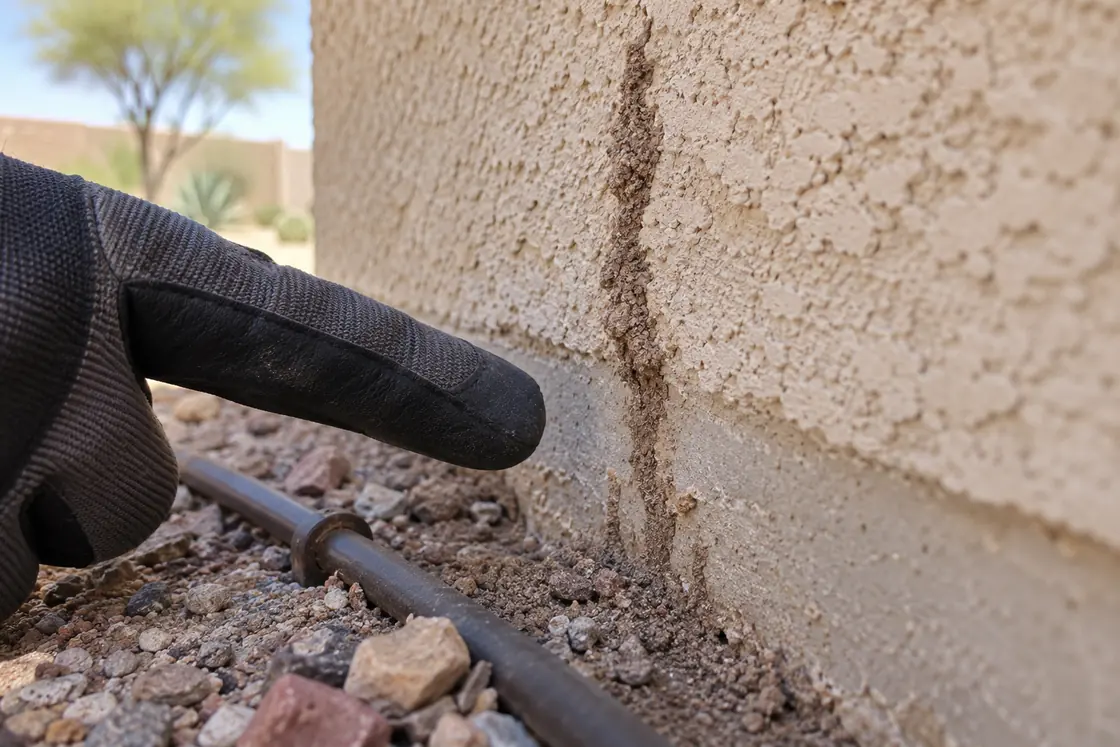
Termites in the Arizona desert
Many people assume termites are a humid-climate problem.
In fact, Arizona has several termite species that thrive in the desert, and they are one of the most common reasons for pest calls in central Arizona.
The main ones in Casa Grande are subterranean termites that live in the soil and travel to food through mud tubes.
How termites get into Casa Grande homes
Most homes here are built on concrete slabs with stucco or block walls.
Termites get in through: - Cracks in the slab and expansion joints, including in the garage - Gaps where plumbing comes up through the slab - The base of stucco walls, where foam insulation or the weep screed meets the soil - Block walls and fences attached to the house - Wood-to-soil contact, such as door frames, posts and landscaping timbers
Monsoon rains soften the soil and trigger swarms, and irrigated landscaping keeps soil near the foundation damp all year.
Where termites show up near Mission Royale
- Mud tubes on the outside of stucco or block walls, or coming out of cracks in the garage floor
- Mud tubes on baseboards, door frames or drywall inside
- Swarms of small winged insects, often after a monsoon rain
- Drywall with small holes, mud spots or damaged paper
- Hollow-sounding or damaged baseboards and trim
The inspection
The technician checks the full exterior foundation and stucco base, block walls attached to the house, the garage slab and walls, interior baseboards, door frames, bathrooms and areas around plumbing, and the attic if needed.
For termites in Casa Grande, the visit starts at the pet door and then follows whatever that shows.
Treatment options
Where termites show up near Mission Royale
A termiticide is applied to the soil along the foundation, through trenching or by drilling small holes in concrete patios, sidewalks and the garage slab that are then patched.
In Casa Grande, termites near downtown Casa Grande are traced from the garage-door sweep, not from a product chosen before anyone looks.
Bait stations
Stations are placed in the ground around the house. Termites feed on the bait and share it with the colony, which eliminates it over time. Bait needs less drilling but depends on regular monitoring.
Fixing conditions
Keeping irrigation water away from the foundation, fixing leaks, removing wood-to-soil contact and keeping landscaping and debris away from the stucco base all help treatment last longer.
Damage to drywall
In Arizona, termites often eat the paper face of drywall, leaving small holes and mud spots. That damage is usually cosmetic but shows active termites.
Repairs are drywall work, not part of the treatment, but knowing where the damage is lets you get it fixed.
For termites in Casa Grande, the visit starts at the weep holes and then follows whatever that shows.
We do not sell termite treatment without finding termites or a real risk. We do not quote without inspecting.
And we do not leave you unclear about what happens after the treatment: you get told what follow-up or monitoring is included, for how long and what renewal costs.
Irrigation and the foundation
Drip lines, sprinklers and flood irrigation keep the soil next to many Casa Grande homes damp all year, which is exactly what subterranean termites need in a dry climate.
Point emitters away from the stucco, fix leaking lines and keep plants a couple of feet from the foundation where you can. Small changes like these make every treatment last longer.
Buying or selling a home
In Arizona, a Wood Destroying Insect Inspection Report is common in home sales. If you need one, say so when you call so the right inspection is scheduled.
Monsoon swarms
Many Casa Grande homeowners first notice termites when a monsoon storm passes and, a day later, swarms of small winged insects come out of a crack in the slab, a door frame or the ground beside the house.
Swarmers themselves do not damage the house, but they show that a mature colony is nearby.
Save a few in a sealed bag, take a photo of where they came out, and call to have the house inspected.
The technician will check the spot the swarm came from and the rest of the foundation.
What to look for near the Florence Boulevard corridor
Call when you see mud tubes, swarmers or damage, or before buying a home. Call now.
Termite quick facts for Casa Grande
- Desert subterranean termite (*Heterotermes aureus*): the main termite in Arizona homes. It lives in the soil and builds thin mud tubes on slabs, stucco and drywall.
- Desert termite (*Gnathamitermes perplexus*): builds mud sheets on desert plants and dead wood; it rarely attacks homes but is often mistaken for a structural pest.
- Swarm season: mostly during the monsoon, after the first summer storms, often in the evening.
- Treatment types: a liquid soil termiticide applied as a barrier, or bait stations placed around the home.
- Regulator: pest control in Arizona is licensed by the Arizona Department of Agriculture, Pest Management Division.